
What Does Your Church Actually Do?
Acts 3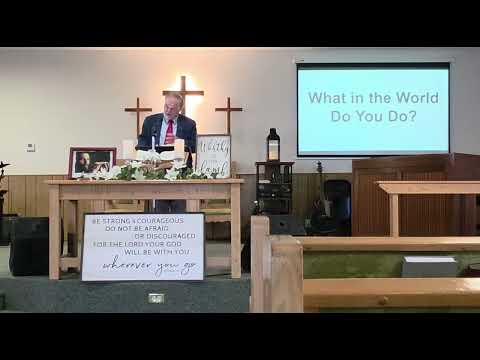
A woman drove into a seminary parking lot with her brother slumped in the backseat — eight months in a coma, every resource gone. She said four words to the acting dean: "I'd like you to heal him." When he told her he didn't have the gift of healing, she drove away with one final question:
"Then what in the world do you do?"
Guest speaker Pastor Vernon Adams brings that question to Paris Church of the Nazarene — and answers it with five things drawn straight from Acts 3 and the New Testament.
From a book picked up at the Cane Ridge meeting house — stories by Fred Kratic, a minister and professor. While acting dean at Philip Seminary, a woman came asking him to come to the parking lot. Her brother had been in a coma for eight months after a car wreck. She had quit her teaching job to care for him. Everything was gone.
The woman"I'd like for you to heal him."
Kratic told her he could pray, but didn't have the gift of healing. Before she drove away:
The woman"Then what in the world do you do?"
People may drive by this church every day and never come in —
quietly asking themselves:
"What in the world do you do?"
Prayer and praise belong together. Prayer should always be prefaced with praise — thanking God for what he's already done before asking for anything new. James 5:16 calls it the effectual fervent prayer of a righteous man — not just prayer, but prayer with weight behind it.
Pastor Adams is a Christian today because someone prayed for him. His grandmother had regular times alone with God in the front parlor room. He would go looking for her, and when he got to that door he would stop when he heard her voice. Pal Whitlock, the pastor at Clintonville Naz, would pray at the church every evening after work. Adams and his wife Sue lived next door — and they could hear him through two walls.
Who would want to go to a church
that does not pray?
There's no point talking to God if we don't believe he can answer. Acts 3:16 says it was faith in his name that gave the lame man perfect soundness.
Hebrews 11:6"Without faith it is impossible to please God. He that comes to God must believe that he is and that he is a rewarder of those who diligently seek him."
You ask God for something this morning —
then trust him and leave it with him
to answer in the best way he sees fit.
Just two letters. A commandment.
Mark 16:15"Go ye into all the world and preach the gospel to every creature."
Going starts right here. Paris is part of the world. Jesus's parable of the great supper expanded outward — streets and lanes first, then highways and hedges, until the house was filled. The church is a missionary church. And what God commanded begins at home before it reaches the ends of the earth.
Peter didn't have silver or gold — but he gave what he had. We give time, talents, and treasures. Pastor Adams's stepfather Jake Jones, an elder at Central Baptist, stopped a casual conversation with this:
Jake Jones"Don't talk to me about tithing if the church is not going to tithe."
His point: if the congregation gives 10%, the church itself should give at least 10% of its income to support world evangelism and missions. A giving church demonstrates it believes something eternal is at stake beyond its own four walls.
John 13:34–35"A new commandment I give unto you, that you love one another as I have loved you. By this shall all men know that you are my disciples — if you have love one to another."
The distinguishing mark of a disciple
is not theology or attendance.
It's love.
And love never fails. The greatest of faith, hope, and love is love. And it doesn't stop at the church doors — love your enemies, pray for those who persecute you, that you may be the children of your Father in heaven.
- Acts 3:1–16 Peter and John heal the lame man at the Beautiful Gate in the name of Jesus Christ of Nazareth.
- James 5:16 The effectual fervent prayer of a righteous man avails much — illustrated by Elijah.
- 1 Timothy 2:1–4 Supplications, prayers, intercessions, and giving of thanks for all men.
- 1 Thessalonians 5:17–18 Pray without ceasing. In everything give thanks. This is the will of God.
- Hebrews 11:6 Without faith it is impossible to please God.
- Mark 16:15 Go into all the world and preach the gospel to every creature.
- John 13:34–35 Love one another — by this all men will know you are my disciples.
- 1 Corinthians 13 Love never fails. The greatest of these is love.
Five core answers from Acts 3 and the New Testament:
- Pray and Praise — effectual, fervent prayer prefaced by thanksgiving
- Have Faith — believe God hears and answers; without faith it's impossible to please him
- Go — fulfill the great commission, starting in your own community
- Give — time, talents, and treasures, including support of world missions
- Love — the distinguishing mark of a disciple, extended even to enemies
First Timothy 2:1 lists supplications, prayers, intercessions, and giving of thanks in the same breath. First Thessalonians 5 follows "pray without ceasing" immediately with "in everything give thanks."
Going starts right here. Paris is part of the world. Jesus's parable outlines mission in concentric rings — streets and lanes first, then highways and hedges, expanding until the house is full.
Faith and hope are oriented toward what we don't yet have — they'll one day be fulfilled and no longer needed. But love never fails. It is the substance of God's own nature and outlasts everything else.
Test Your Understanding
What Does Your Church Actually Do? · Pastor Vernon Adams · April 19, 2026
Join Us This Sunday
Paris Church of the Nazarene · Every Sunday at 10:45 AM
450 Houston Avenue, Paris, Kentucky 40361
RightNow Media — Free for Our Church Family
Free Discipleship Library
As a member of Paris Church of the Nazarene, you get free access to RightNow Media — a massive streaming library of Bible studies, kids' shows, leadership resources, and faith-based content for every stage of life.

It's like the Netflix of Christian media... and it's completely free for you.

What Does Your Church Actually Do?
Acts 3
A woman drove into a seminary parking lot with her brother slumped in the backseat — eight months in a coma after a car accident, every resource gone. She found the dean, opened the door, and said four words: "I'd like you to heal him." When he told her he didn't have the gift of healing, she climbed behind the wheel and asked a question that never left him:
"Then what in the world do you do?"
Guest speaker Pastor Vernon Adams brings that question to Paris Church of the Nazarene — and answers it with five things drawn straight from Acts 3 and the New Testament. It's not a complicated answer. But it's a demanding one.
Pastor Adams opens by sharing a story from a book he picked up years ago at the Cane Ridge meeting house — a collection of stories by Fred Kratic, a minister and professor in the Christian church. For a brief period Kratic was acting dean at Philip Seminary, and one afternoon his secretary told him there was a woman who wanted him to come out to the parking lot.
When he got there, a woman opened the back door of her car. Her brother was slumped in the seat — a senior at the University of Oklahoma who had been in a bad car wreck and had spent the last eight months in a coma. She had quit her job as a schoolteacher to care for him. Every resource was gone. She looked at Kratic and said simply:
The woman"I'd like for you to heal him."
Kratic told her he could pray for her and with her, but that he didn't have the gift of healing. She got behind the wheel and drove away — but not before she turned and asked:
The woman"Then what in the world do you do?"
She didn't give him the chance to pray. She drove off. And that question stayed with Kratic — and has stayed with Pastor Adams — for years. Because it's the same question people passing any church building are silently asking all the time.
There may be people who drive by this church quite often who never come in.
They look over in this direction and ask themselves:
"What in the world do you do?"
That's the question God would ask us as individuals. That's the question God would ask us as a church. And we should have an answer.
The first answer to "What in the world do you do?" is prayer — and Pastor Adams is quick to add that prayer and praise belong together. You cannot separate them. You should not separate them.
We should never come to God asking him to do this or that
without first thanking him for what he's already done,
who he is, and what he's going to do.
James 5:16 calls it the effectual fervent prayer of a righteous man — not just prayer, but prayer with heat and weight behind it. And it avails much. The example given is Elijah — a man, the scripture notes carefully, subject to like passions as we are. Not superhuman. Not elevated above us. A man who prayed and the rain stopped for three years and six months. A man who prayed again and the earth brought forth fruit.
Pastor Adams tells of two people who shaped his understanding of prayer. First, his grandmother — who had regular, private times alone with God in the front parlor room, a room the family didn't otherwise use. As a young boy he would go looking for her, not find her in the kitchen or garden, and know exactly where she was. He would stop at the door when he heard her voice.
Second, Pal Whitlock — the pastor at Clintonville Church of the Nazarene, who also worked at General Electric. Every evening after coming home from work, he would walk down to the church and pray. Pastor Adams and his wife Sue lived in the house next door when they were first married, and they could hear him — through two walls.
Pastor Adams"After a while his volume would lift and he was in prayer. We knew that he was there praying."
Who would want to attend a church that does not pray? That takes no requests and cares nothing about the needs of its people?
There is no point talking to God if we don't believe he can answer. Prayer without faith is an empty exercise. The two are inseparable — and that's the point Peter makes in Acts 3 when the crowd gathers around the healed man and stares at him in wonder.
Acts 3:16"His name through faith in his name hath made this man strong — yea, the faith which is by him hath given him this perfect soundness in the presence of you all."
Three scriptures frame this point:
Mark 11:22 — Jesus said simply: "Have faith in God." Trust him. Have confidence. Believe in him.
Hebrews 11:6 — "Without faith it is impossible to please God." Not difficult. Not unlikely. Impossible. For he that comes to God must believe that he is and that he is a rewarder of those who diligently seek him.
James 1 — Ask in faith, nothing wavering. For the one who wavers is like a wave of the sea, driven with the wind and tossed. Let not that man think he shall receive anything of the Lord.
You ask God for something this morning —
then trust him and leave it with him
to hear and to answer in the best way he sees fit.
The third answer is the shortest one. Just two letters. A commandment, not a suggestion.
Mark 16:15"Go ye into all the world and preach the gospel to every creature."
Going starts right here. Paris is a part of the world. Jesus told a parable about a man who made a great supper and sent his servants out to fill the seats — first into the streets and lanes of the city, then into the highways and hedges, compelling them to come in that my house may be filled.
The same pattern applies to the church. Go into your neighborhood. Go into your city. Go into your county. Keep expanding — all the way to the farthest regions of the world, so that every creature may hear the gospel.
The church is to be a missionary church.
What God has commanded us to go do
begins right here — and reaches to the ends of the earth.
Pastor Adams notes that he's already heard about it happening here: Pastor Curtis and his wife are already out in the community, already involved in local activities, already visiting among the people of Clintonville before coming to Paris each Sunday morning. That's what going looks like in real life.
When the lame man at the gate Beautiful held out his cup, he expected to receive something. You can't pass people by and pretend not to see them. Peter didn't. He looked the man in the eye and said:
Acts 3:6"Silver and gold have I none, but such as I have give I thee. In the name of Jesus Christ of Nazarene, rise up and walk."
He gave what he had. That's the model — give your time, give your talents, give your treasures. A giving church is a healthy church.
Pastor Adams's stepfather, Jake Jones — an elder at Central Baptist Church — interjected something into a casual conversation one day that stopped Adams cold:
Jake Jones"Don't talk to me about tithing if the church is not going to tithe."
He meant it plainly: if the church is going to ask its members to tithe, the church itself ought to give at least 10% of its income to missions. That's how the Church of the Nazarene is set up — each congregation is expected to give a percentage to support world evangelism and the missionaries God has called and placed on the field.
A church that doesn't give
is a church that has quietly stopped believing
that what happens beyond these walls matters.
The fifth answer is the one Jesus closed his final prayer with. In John 17, the whole chapter is the Lord's prayer to his Father — and the last two verses land on one subject.
John 17:26"I have declared unto them your name, and will declare it, that the love wherewith you have loved me may be in them, and I in them."
The distinguishing characteristic and true real evidence that we are Christians — the thing that tells the world we belong to God — is not our theology, not our attendance, not our programs. It's love.
John 13:34–35"A new commandment I give unto you, that you love one another as I have loved you. By this shall all men know that you are my disciples — if you have love one to another."
There are always disagreements in the church.
But love will smother them out —
we can disagree strongly and still love each other
and still endeavor to keep the unity of the body.
First Corinthians 13 devotes an entire chapter to this one subject, and sums it up in two lines: Love never fails. And now abides faith, hope, and love — but the greatest of these is love.
And this love doesn't stop at the church doors. Jesus said in the Sermon on the Mount: love your enemies. Pray for those who persecute you. That you may be the children of your Father in heaven.
- Acts 3:1–16 Peter and John at the Beautiful Gate — the lame man healed in the name of Jesus Christ of Nazareth.
- James 5:16 The effectual fervent prayer of a righteous man avails much — illustrated by Elijah.
- 1 Timothy 2:1–4 Paul exhorts supplications, prayers, intercessions, and giving of thanks for all men.
- 1 Thessalonians 5:17–18 Pray without ceasing. In everything give thanks. This is the will of God.
- Hebrews 11:6 Without faith it is impossible to please God.
- Mark 11:22 Jesus said: "Have faith in God."
- Mark 16:15 Go into all the world and preach the gospel to every creature.
- John 13:34–35 Love one another as I have loved you — by this all men will know you are my disciples.
- John 17:26 Jesus's final prayer — that the love the Father has for the Son may be in his people.
- 1 Corinthians 13 The love chapter — love never fails; the greatest of these is love.
Acts 3 gives us a picture of the early church in action — and from it and the surrounding New Testament, five core answers emerge:
- Pray and Praise — effectual, fervent prayer prefaced by thanksgiving (James 5:16, 1 Thessalonians 5:17–18)
- Have Faith — believe God hears and answers; without faith it is impossible to please him (Hebrews 11:6)
- Go — fulfill the great commission, starting in your own community (Mark 16:15)
- Give — time, talents, and treasures, including support of world missions
- Love — the distinguishing mark of a disciple, extended even to enemies (John 13:35)
Peter and John were on their way to the temple at the hour of prayer when a man lame from birth asked them for money. Peter didn't have silver or gold — but he had something more. He looked the man in the eye, took him by the hand, and said "In the name of Jesus Christ of Nazareth, rise up and walk."
The passage also shows that when the church operates in that power, people notice — they run together wondering, they ask questions, they open up to hear the gospel. The miracle created the moment for the message.
First Timothy 2:1 lists "supplications, prayers, intercessions, and giving of thanks" in the same breath — they're not separate activities, they're different dimensions of the same posture before God. First Thessalonians 5:17–18 says to "pray without ceasing" and in the very next breath: "in everything give thanks."
As Pastor Adams puts it: prayer should always be prefaced with praise.
Jesus's parable of the great supper (Luke 14) outlines the geography of mission in concentric rings — first the streets and lanes of the city, then the highways and hedges, expanding outward until the house is full. The great commission in Mark 16:15 starts with go — but it doesn't say start far away.
For a local church this looks like: knowing your neighbors, visiting your community, supporting missionaries who go to places you can't reach yourself, and giving financially so the mission keeps moving. A church that never goes anywhere hasn't yet understood the commission.
Jesus said more about money than almost any other subject — because that's where people have most of their problems and most of their heart. The principle in Acts 3 is "such as I have, give I thee." We give what we have, not what we wish we had.
His point was that if the congregation is asked to give 10%, the church itself should model that by giving at least 10% of its income to support world evangelism and missions. Generosity is not just a personal discipline — it's a congregational one. A giving church demonstrates that it believes something eternal is at stake beyond its own four walls.
Faith and hope are oriented toward what we don't yet have or see — they will one day be fulfilled and no longer needed. But love, as 1 Corinthians 13 says, never fails. It doesn't become obsolete when the promise arrives. It is the substance of God's own nature (1 John 4:8) — and therefore the thing that outlasts everything else.
And this love extends beyond the congregation. Jesus in the Sermon on the Mount said to love your enemies and pray for those who persecute you — that you may be the children of your Father in heaven. Love is the church's most visible credential to a watching world.
Test Your Understanding
What Does Your Church Actually Do? · Pastor Vernon Adams · April 19, 2026
Join Us This Sunday
Paris Church of the Nazarene · Every Sunday at 10:45 AM
450 Houston Avenue, Paris, Kentucky 40361

Call Us Today

Email Us

Our Location
450 Houston Avenue, Paris, KY 40361


Copyright © 2026 All Rights Reserved.
Paris Church of the Nazarene is a 501(c)(3) nonprofit organization. Our mission is to "Go Out! Share Hope".
Legal Name - Paris Church of the Nazarene
EIN - 41-5234223
Call Us Today
Email Us
Our Location
450 Houston Avenue, Paris, KY 40361
Copyright © 2026 All Rights Reserved.
Paris Church of the Nazarene is a 501(c)(3) nonprofit organization. Our mission is to "Go Out! Share Hope!".